Why Private Villas Change Everything About the Retreat Experience
Close your eyes and imagine the most vulnerable moment of your life. Now imagine experiencing it in a room with a stranger sleeping three feet away from you. Imagine the overhead lights, the thin walls, the shared bathroom where you queue in the morning while trying to hold the weight of what surfaced the night before.
This is the reality at most healing retreats around the world. Shared dormitories, communal bedrooms, bunk beds in converted houses. The rationale is usually economic — fitting more people into fewer rooms keeps costs down. But when you are doing the deepest, most tender work of your life, economy should not come at the cost of safety.
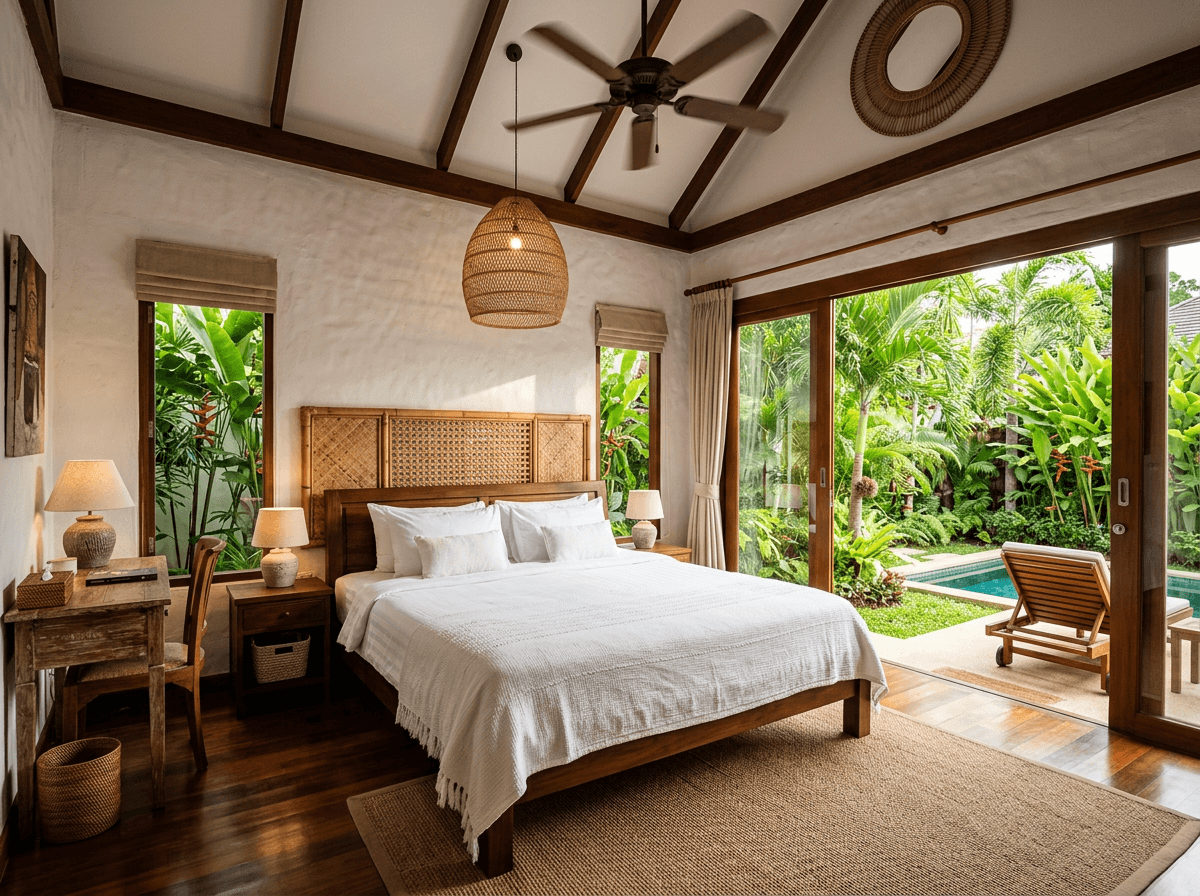
At Narai Healing Sanctuary, every guest receives their own private villa. Not a room. Not a suite. A villa — with its own kitchen, bathroom, living space, and private garden. This is not an amenity. It is a fundamental part of the therapeutic model.
Processing Space: Why You Need Privacy After Ceremony
After a Guided Transformation Session, something has opened inside you. Emotional material that has been compressed for years — sometimes decades — begins to surface. Grief, relief, confusion, clarity, exhaustion, and tenderness can all arrive within the same hour. This is not an experience that benefits from an audience.
In shared accommodation, guests are forced to manage not only their own experience but also the social dynamics of cohabitation. Do I cry quietly? Do I turn the light on to journal? Is my roommate asleep? Should I pretend I'm fine? These micro-negotiations consume energy that should be directed toward healing. They create a performance layer over what should be a deeply private process.
When you return to your own villa after a session, there is no one to perform for. You can lie on the floor and stare at the ceiling. You can sit in the garden and watch the rain. You can take a long bath and let your body regulate at its own pace. The villa becomes a decompression chamber — a space where the work of the session can continue without interruption.
"Privacy is not an indulgence. When you are doing the work of transformation, privacy is a clinical necessity."
The Nervous System Needs Safety to Heal
Healing is not just an emotional process — it is a physiological one. Your nervous system must feel safe enough to move out of its habitual stress response and into a state of rest and repair. This is the fundamental principle of polyvagal theory: the body heals when it perceives safety, and it contracts when it perceives threat.
Shared living spaces, however well-intentioned, introduce unpredictability. Another person's sleep patterns, noise, energy, and emotional state all register in your nervous system as variables that need to be monitored. This is not a conscious choice — it is a biological response. Your body is scanning for safety, and when you cannot fully control your environment, it stays alert.
A private villa eliminates this background vigilance. You control the temperature, the light, the sound, and the pace. You sleep when you need to sleep. You eat when you need to eat. You are alone with your own experience, and your nervous system can finally stop scanning and start healing.
Your Villa as Sanctuary: Kitchen, Garden, and Private Space
Each villa at Narai is more than a bedroom. It is a self-contained living space designed to support every phase of your retreat. The kitchen allows you to prepare simple meals or tea between scheduled mealtimes — important when your body's rhythms shift during deep therapeutic work. The private bathroom means you never have to wait, rush, or share a space where you might need to be alone with yourself.
The garden is perhaps the most underestimated feature. Many guests find that their most profound insights don't come during ceremony — they come in the quiet hours afterward, sitting outside under the trees, listening to the sounds of the Thai countryside. These unstructured moments are where integration happens. They cannot be scheduled, and they cannot happen in a shared room.
Over the course of five days, the villa becomes yours in a way that goes beyond occupancy. It becomes familiar. Safe. It holds your rhythms, your rituals, your quiet morning practices. It becomes part of the therapeutic container — not just a place to sleep, but a space that actively supports your transformation.
Integration Happens in the Quiet Moments
There is a common misconception that healing happens in the big moments — the ceremony, the breakthrough, the tears. In reality, the most important work happens in the spaces between. The morning after a session, when you sit with your journal and notice a thought you have never had before. The afternoon when you realise the tightness in your chest has softened. The evening when you cook a simple meal and feel, for the first time in months, genuinely present.
These moments require solitude. Not isolation — solitude. The difference is crucial. Isolation is being alone against your will. Solitude is choosing to be with yourself, fully and without distraction. A private villa makes this choice possible. The group sessions provide community, connection, and shared experience. The villa provides the counterbalance: a space to metabolise what the group work has stirred.
"The ceremony opens the door. Integration walks through it. And integration needs a room of its own."
Solo vs Shared: Choosing What Works for You
We understand that some guests — particularly couples or close friends — may prefer to share a villa. This option is available and honoured. But the default at Narai is one guest, one villa. This is a deliberate choice rooted in years of clinical experience.
When couples attend a retreat together, their individual processes can become entangled. One partner's breakthrough may unconsciously pressure the other. One person's pace of processing may not match the other's. In separate villas, each person has the freedom to move at their own rhythm and come together during group activities from a place of wholeness rather than obligation.
For solo travellers, the private villa removes the social anxiety that often accompanies shared accommodation. There is no need to make small talk when you are emotionally raw. No need to negotiate bedtimes. No need to manage another person's energy when you are learning to manage your own.
How the Villa Becomes Part of the Therapeutic Container
In clinical psychology, a "therapeutic container" refers to the boundaries, structures, and environmental conditions that allow deep emotional work to happen safely. At Narai, the container is not just the ceremony space or the therapist's presence — it is the entire environment: the sanctuary grounds, the ocean nearby, the group dynamic, and your villa.
Your villa holds you at the moments when no other person can. At three in the morning, when a memory surfaces and you need to cry. At dawn, when you step into your garden and feel the dew under your feet. At dusk, when the day's work is done and you can finally exhale. These are not small things. They are the conditions under which genuine transformation becomes possible.
Most retreat centres treat accommodation as logistics — a place to put people between sessions. At Narai, we treat it as medicine. The space you inhabit during your retreat is not separate from the work. It is part of it.
If you are considering a healing retreat and wondering whether the accommodation matters, the answer is unequivocal: it matters more than almost anything else. Your nervous system knows the difference between a shared room and a sanctuary. Your healing will too. View our retreat programmes and villa details to find the right fit for your journey.